
 Translate
King County Wastewater Treatment Division (WTD) works to keep the Brightwater Treatment Plant (Brightwater) efficient and reliable. As the region grows and regulations change, we must maintain and update our facilities. We do this through capital improvement and asset management projects.
We design and build projects to:
- Meet regulations
- Save energy
- Improve water quality
- Add capacity for growing communities
- Increase efficiency and reliability
- Fix or replace outdated equipment

Outdoor view of the south end of the Brightwater Treatment Plant facility. This includes the odor control area (white pipes at right).
Inside the plant, projects help us manage today’s wastewater flows in a treatment system built for the future. Many projects help save energy while maintaining or improving performance. Brightwater engineers and operators regularly look for ways to reduce energy use.
Projects vary in size from small lighting upgrades to large construction projects. Today, many projects are underway or planned in the treatment plant. Projects help save energy, improve efficiency, and maintain key systems.
In the Brightwater natural areas, you may see projects that maintain landscaping, trails, public art, and more. Environmental projects help us manage the landscape and meet permit requirements. These landscapes help filter stormwater and provide wildlife habitat. After we create or restore landscapes, we monitor them and make changes as needed.
More details on some Brightwater projects are included below. Select the drop down to learn more!
Please note that construction schedules are subject to change.
Improvement projects
Project overview: This project replaces old membrane cassettes in four tanks at Brightwater. The new membranes are more efficient and use updated technology. Thanks to dedicated maintenance from Brightwater staff, the original membranes lasted five years longer than expected.
Membranes are very fine filters that remove tiny particles from wastewater. The membranes sit inside metal cassettes. Many cassettes together make up a train. This system filters large amounts of wastewater.
Project impacts: Work takes place inside the treatment plant. Plant operations will continue normally. There will be no community impacts. As part of the project, crews remove the old membrane cassettes. Metal parts and pallets are recycled nearby. Operators use cranes to place new membrane cassettes into the train. Then engineers and operators test and set up the system.
Project benefits: The new membranes are more efficient. They use updated membrane filters that allow us to treat the same amount of water with only 14 cassettes instead of 20. This saves time and money on maintenance. It makes the system more resilient and flexible in the future.
Construction schedule: 2026

A Brightwater utility worker uses a crane to move the new membrane cassette into an open space in the tank.
Watch a short video to learn more about this project
Project overview: This project will install 20 new membrane cassettes in two empty trains at Brightwater. The new membrane cassettes use the latest technology. Adding them increases treatment capacity and provides backup for the system.
Project impacts: Work takes place inside the treatment plant. Plant operations will continue normally. There will be no community impacts. Operators use cranes to install the new membrane cassettes. Engineers and operators then test and set up the system.
Project benefits: The new membrane filters save time spent on maintenance and money. They add capacity and make the system more flexible and reliable.
Construction schedule: 2026
Project overview: This project replaces a temporary magnesium hydroxide system with a permanent one. Magnesium hydroxide helps balance pH levels by making sure the water does not get too acidic. This helps beneficial microbes work better in the aeration tanks.
Project impacts: Work takes place inside the treatment plant. Operations will continue normally. There will be no community impacts. Crews will pour a reinforced concrete foundation. Then, the Magnesium Hydroxide tank and a control enclosure will be installed.
Project benefits: The permanent system will improve wastewater treatment performance and worker safety. Over time, it will improve system reliability and may reduce costs.
Construction schedule: 2026

This photo shows the magnesium hydroxide tank being assembled in a warehouse. This tank will be installed at Brightwater.
Project overview: Loop Compost is made by transforming Loop® Biosolids (Loop) into a high-quality compost for home gardens and landscapes. To make Loop Compost, Loop is blended with clean, woody material. This makes compost that is rich in nutrients and free of pathogens.
WTD is studying how nutrients and carbon in Loop Compost affect soil health and plant growth. We are comparing Loop Compost to other products. This includes a fertilizer and compost from food and yard waste. In April 2026, we installed the gardens at South Treatment Plant in Renton. In June 2026, we installed four raised beds next to the Brightwater Education Center classrooms. Each garden bed has a different soil treatment. We will monitor soil quality over time and evaluate plant growth.
Project impacts: People can see the garden beds on the west side of the Brightwater Education Center classrooms.
Project benefits: Early findings at South Plant show that all compost improves soil quality. Loop Compost grows plants better because it is rich in nutrients. At Brightwater, recent photos show significant growth differences between compost and fertilized treatments.
Construction schedule: We installed four raised beds at Brightwater in June 2026. The beds will be planted with cover crop in the fall and monitored for soil health changes over time.
Photos of two raised beds at the Brightwater Demonstration Garden from both sides in August 2026. Left: Loop Compost mixed 1 to 1 by volume with soil. Right: Fertilizer plot with Nitrogen, Phosphorus, Potassium, and Sulfur.

The four garden beds the day they were planted at Brightwater in early June 2026.
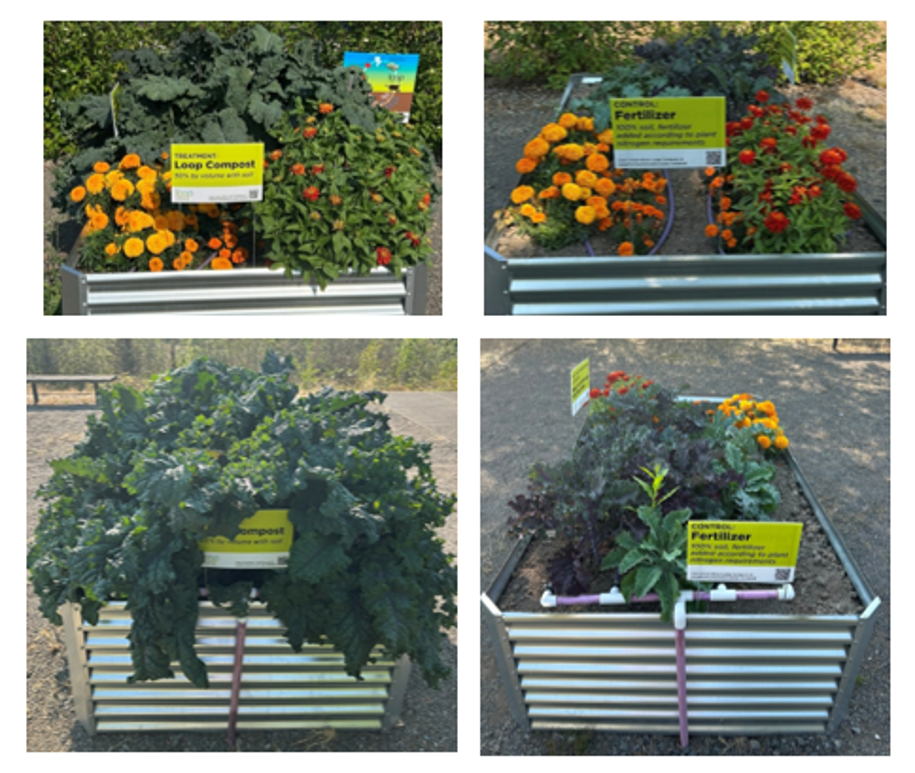
Photos of two raised beds at the Brightwater Demonstration Garden from both sides in August 2026. Left: Loop Compost mixed 1 to 1 by volume with soil. Right: Fertilizer plot with Nitrogen, Phosphorus, Potassium, and Sulfur.
To learn more about Loop Compost visit LoopForYourSoil.com/Loop-Compost.
Project overview: This project installs two air vacuum valves on the recycled water pipe at Brightwater. Recycled water flows through this pipe from the treatment plant to the Brightwater Influent Pump Station in Bothell.
Project impacts: Work will happen near the Brightwater entrance by the water molecule art piece. During construction, visitors may need to follow single lane traffic. Flaggers and signs will guide people. There may be more noise and trucks in the area. The Brightwater trails, Education Center, and treatment plant will maintain normal operations.
Project benefits: These valves improve safe drainage. They also protect the recycled water pipeline against a major leak. Without air/vacuum valves, a large leak can cause strong vacuum pressure, which could cause the pipe to collapse.
Construction schedule: 2027
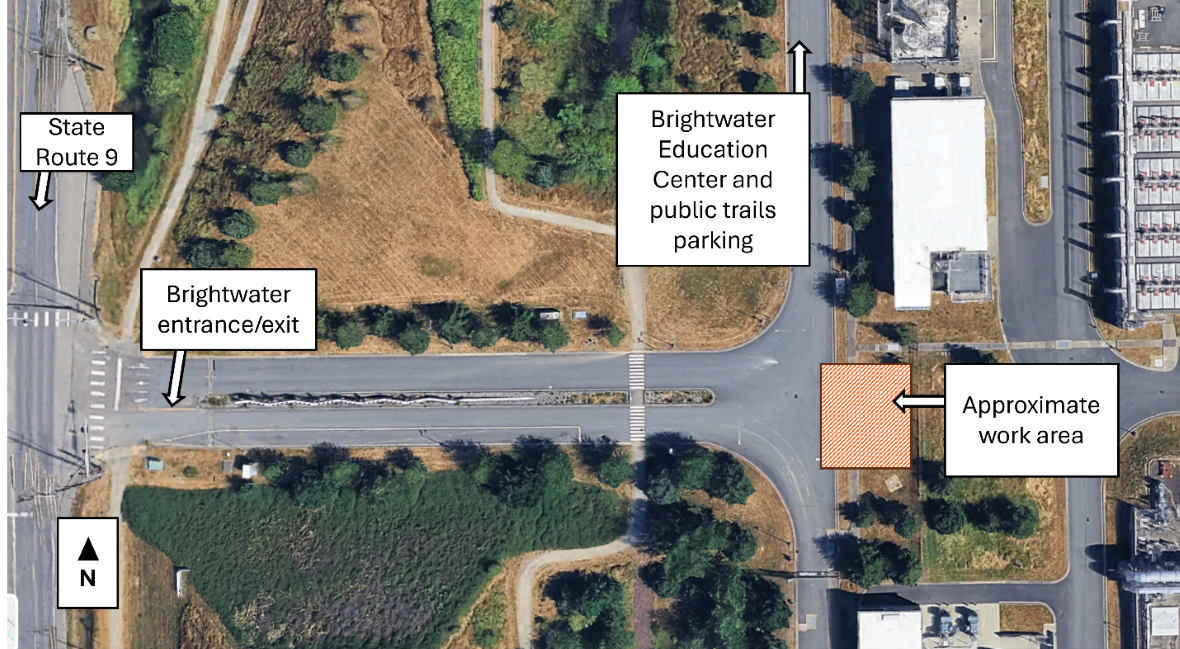
This map shows the approximate work area near the Brightwater entrance.
Project overview: This project aimed to reduce erosion on Alpha Hill, a large hill in Brightwater’s south trails area. Preventing soil erosion protects Little Bear Creek, a nearby salmon-bearing stream. Alpha Hill is closed to the public. Activity like walking or running on the steep slopes can cause soil to wash into the creek.
Project impacts: The design included a rock wall, fencing, and new plants. During construction, a section of nearby trail would be temporarily closed to keep people safe. This project would not change access to the three miles of maintained trails at Brightwater.
Project benefits: The improvements would protect endangered salmon and improve water quality. New plants would help absorb runoff, provide habitat, and improve resiliency during droughts.
Construction schedule: As of 2025, the project is on hold due to increasing costs.
Reference materials:
- Alpha Hill project trail map
- Mapa de senderos del proyecto de Alpha Hill
- Alpha Hill Project Update: Construction expected to begin in January
- Brightwater News – November 2024
- Construction starting as early as mid-October (Español)
- Alpha Hill closed for restoration; work expected to begin later this year
- Work expected to begin this summer
- Alpha Hill project expected to begin May 2024
- Soil Sampling on Alpha Hill planned for April 10. No trail disruption expected from this work.
- Alpha Hill fact sheet 2023 / Informe del proyecto de Alpha Hill 2023