
 Translate
Elliott West Wet Weather Treatment Station upgrade
King County is planning to upgrade the Elliott West Wet Weather Treatment Station (EWWTS). The upgrade will ensure compliance with stricter environmental regulations, meet the demands of a growing population, and handle a changing climate.
Project description
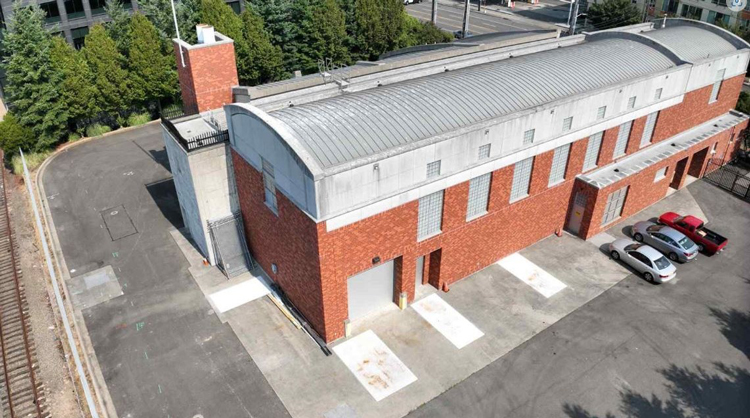
King County Wastewater Treatment Division is planning to make improvements to the Elliott West Wet Weather Treatment Station or EWWTS. Since 2005, EWWTS has helped keep Elliott Bay cleaner by treating stormwater and wastewater during wet weather. It removes solids and disinfects the polluted water to protect water quality in the bay. If EWWTS was not in operation, these pollutants would enter Elliott Bay in what is called a Combined Sewer Overflow or CSO. There are many CSO outfall locations throughout Seattle. CSOs are explained further in the Overview section.
Now, new rules from the Washington State Department of Ecology require upgrades at the station. These changes will help the station meet updated water quality standards and continue to protect Elliott Bay from pollution in the future.
Wet weather treatment stations such as EWWTS also make our system resilient to climate change. Instead of light to moderate rain showers spread over hours or days, Seattle is expected to see more severe showers in shorter periods of time. These brief but more severe storms can rapidly fill City of Seattle’s and King County’s pipes, increasing the likelihood of overflows, backups, and emergency bypasses of untreated wastewater. This project is a major investment to ensure King County continues to protect public health and the environment for decades to come. The station upgrade will help ensure that EWWTS can adequately treat the combined stormwater and wastewater from these storms by simplifying the disinfection process, improving the operation of pumps, and improving the solids removal process.
More information about the upgrade plans will be available this summer and fall. To stay updated, subscribe to our email list.
Project update
Fall 2026
Thank you to everyone who joined us at the EWWTS facility tour!
On Friday, August 21, our community engagement team hosted an open house and facility tour at the EWWTS facility, with support from operations staff, architects, and project experts who shared the latest design updates with participants. 17 community members stopped by throughout the event, and we thank each of you for your enthusiasm, feedback, and thoughtful questions.
Community Concerns Raised
During the tour, some residents shared concerns about:
- Project-related tree removal
- Potential noise impacts, including whether the building could reflect road noise toward nearby homes
- Whether street-facing trees could help buffer road noise near the facility
We appreciate this input and are considering it as part of ongoing design and planning discussions. Our team is reviewing potential options through the design process and will share updates as this work continues.
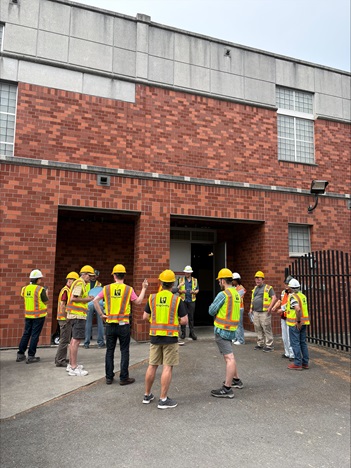
Community Members tour the EWWTS facility during the August 21 open house.
Couldn't make it in person? Take our virtual tour!
Our project team is bringing the tour to you. Check out what happens behind the scenes at EWWTS.
What's next for EWWTS
As we move into Fall, our project team is working toward final design of the facility upgrade – the phase in which engineering and architectural plans are completed and approved to meet all applicable King County and City of Seattle codes, standards, and regulatory requirements. We will continue to share updates as we complete this phase. For real-time updates, please subscribe to our project listserv.
We will continue to identify areas where the community can provide input and help make decisions with us as 2026 wraps up and 2027 begins.
Outreach Materials
Did you know you can access all our in-person outreach flyers, handouts, and materials online? Visit our public engagement page to learn more about how we have taken your feedback into consideration in our final design plans, building height, and the Envision process that ensures our building supports sustainable, resilient, and community-centered outcomes.
Previous project updates
- Just over a week left 'til our online briefing on May 29! May 21, 2025
- Have you heard about the upgrade coming to the Elliott West Wet Weather Treatment Station? May 2, 2025
- Maintenance work near Elliott West Facility February 13, February 12, 2025
- Updates on the Elliott West Wet Weather Treatment Station upgrade, June 2024
- Survey for Elliott West Wet Weather Treatment Upgrade project closes Sunday, Sep 24 at midnight! September 22, 2023
- Elliott West Wet Weather Treatment Upgrade project website is now LIVE! September 5, 2023
- New Project Alert! The Elliott West Wet Weather Treatment Station is getting an upgrade and we need your input! August 25, 2023
Frequently asked questions
Project overview
This project will bring the facility into compliance with updated, stricter regulations. EWWTS has not always achieved full compliance under West Point Treatment Plant's National Pollutant Discharge Elimination System (NPDES) permit. This permit allows West Point and its facilities to release wastewater into bodies of water and contains requirements that ensure that operations maintain water quality standards.
The Department of Ecology (Ecology) issues and enforces the NPDES permit. Ecology is currently updating West Point’s NPDES permit.
As we upgrade EWWTS to meet these updated regulations, we are reflecting on what we have learned over the last 20 years. This includes correcting flaws in the original design and learning from operator experiences. We are also updating to include industry-leading technologies such as those used in the recently completed Georgetown Wet Weather Treatment Station. Furthermore, we are assessing climate change modeling for King County to assess how this new facility can solve two things: adapt to the way climate change will alter Puget Sound’s environment and use renewable and clean power.
Project benefits include:
- Better water quality in Elliott Bay
- Full compliance of EWWTS with West Point Treatment Plant’s NPDES Permit
- Reduced untreated CSO discharges
Once the upgrade project is complete, Elliott West will use screening, ballasted sedimentation, and Ultraviolet (UV) disinfection. The screening process utilizes mechanical screens to remove large debris, such as tree branches and toilet paper, from wastewater. Ballasted sedimentation is a treatment method where chemical and polymer are added to wastewater to form flocculated or “clumped” particles with suspended solids, a specialized sand (called ballasts) are then used to allow flocculated particles to attach to it, and a series of settling tubes or plates are used to settle these solids out of wastewater. This is done by running wastewater through two channels or “trains” that consist of a series of tanks for chemical, polymer and sand to interact with wastewater solids. This part of the process removes at least 80% of the suspended solids and other pollutant bonded to the suspended solids.
After this, wastewater moves to the next process: UV disinfection. Here, wastewater flows through one of a few channels that contain several UV banks, each of which contains multiple UV lamps. The banks sit in the channel allowing wastewater to flow around the UV lamps. There are many UV lamps submerged in wastewater to ensure complete exposure of wastewater to high intensity of UV radiation. The UV light disinfects wastewater, inactivating the microscopic pathogens that may pose a health risk to people and wildlife.
To see how Elliott West’s technology will function, you can watch our video about how the technology at the Georgetown Wet Weather Treatment Station works.
Where has the advanced primary treatment technology planned for the Elliott West Wet Weather Treatment Station been used successfully?
The Georgetown Wet Weather Treatment Station has been utilizing this method of treatment since it began operations in November of 2022. So far, Georgetown has kept more than 32 million gallons of polluted stormwater and wastewater from reaching the Duwamish River. Additionally, the Bremerton CSO treatment facility has successfully implemented this technology since 2003. Learn more about the technology used at the Bremerton CSO treatment facility- ballasted sedimentation and UV disinfection.
The upgraded EWWTS facility will need to achieve more stringent water quality standards to meet full compliance under the NPDES permit.
To accomplish this, our project team worked with operations and maintenance staff to identify facility upgrade options that would best meet the NPDES permit standards.
King County considered different criteria to select the best upgrade method. These criteria include:
- Environmental and social impacts
- Operations and maintenance needs
- Lessons learned from the design and operation of Wastewater Treatment Division’s newest CSO facility: Georgetown Wet Weather Station
- Schedule and cost impacts
The selected upgrade method at EWWTS will include improvements to the current facility and construction of a new, larger facility on the parcel directly south, which is also owned by King County. The larger facility is required for new technology and for additional storage capacity. EWWTS will treat the same amount of sewage and stormwater after the upgrades are completed.
We are currently designing the EWWTS upgrades. The design will follow the best alternative that we identified to meet full compliance with the NPDES permit. Once we have the shell of a design, there will be opportunities to provide input on design features such as:
- Facility architecture aesthetics
- Facility landscaping
- Identifying reasonable solutions for construction impacts
We anticipate that design workshops will occur in late 2024. From there, King County will address community concerns and refine the design concept in 2025 and 2026. The design process is expected to last through 2027. Construction will immediately follow.
Much of Seattle was built using a combined sewer system. A combined system uses the same set of pipes to carry both sewage and stormwater. In the neighborhoods around EWWTS, this combination goes to the West Point Treatment Plant in Magnolia to be treated.
During heavy rain, pipes can fill with stormwater that runs off roofs, driveways, and streets. When the system is overwhelmed, it is designed to overflow into waterways. This prevents sewer backups into homes and businesses. These overflows are called combined sewer overflows, or CSOs. EWWTS helps reduce untreated overflows into Elliott Bay by treating stormwater and wastewater during heavy rain.
This project will utilize a collaborative delivery method known as General Contractor/Construction Manager (GC/CM). This differs from the Design-Bid-Build (DBB) project delivery method in several ways.
Using DBB delivery, a design consultant is hired to help design the project, then a construction contractor is selected to build the project through a competitive bidding process. With GC/CM delivery, the construction contractor is brought in earlier to provide input during the design process. GC/CM delivery can reduce constructability challenges and reduce risks for all parties helping to deliver the project.
Please visit King County’s Upcoming contract opportunities page for procurement-related updates.
What is Envision?
Envision is a sustainability rating system developed by the Institute for Sustainable Infrastructure (ISI). It assesses infrastructure projects across five categories:
- Quality of Life
- Leadership
- Resource Allocation
- Natural World
- Climate and Resilience
Projects are rated from Verified to Platinum, with Platinum being the highest level of achievement in sustainable and resilient infrastructure.
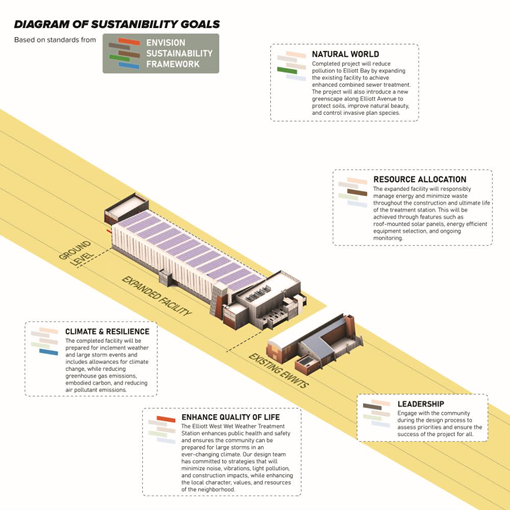
View of existing and expanded treatment facility with sustainability goals based on the envision framework.
The EWWTS project is actively pursuing Envision Platinum certification, demonstrating King County’s commitment to sustainable infrastructure. Key sustainability and resilience strategies include (but are not limited to):
- Climate adaptation and risk reduction integrated into design and operations
- Energy-efficient systems and potential use of renewable energy sources
- Water quality protection through advanced treatment technologies
- Community and interested party engagement to ensure equitable outcomes
- Habitat preservation and restoration to support local ecosystems
- Lifecycle cost analysis and materials reuse to minimize environmental impact
Protecting water quality in Elliott Bay
The Elliott West Wet Weather Treatment Station (EWWTS) is being upgraded to meet updated National Pollutant Discharge Elimination System permit requirements from the Washington State Department of Ecology. This permit helps make sure that water discharged from the EWWTS during heavy rain events meet federal and state water quality standards.
Upgrading wastewater treatment for compliance and environmental protection
To meet the updated permit requirements, the project will make the wastewater treatment station work better by installing a new screening system, a high-rate clarification system for solids removal, and UV disinfection. These additions will catch debris, remove solids, and kill harmful bacteria in the water. If these changes are not made, WTD would be at risk of not complying with its permit, which may lead to fines and untreated water entering Elliott Bay during heavy rain events. This could harm public health and marine life, pollute the water, and affect nearby parks.
Adapting the station for future weather challenges
We are designing the expanded station to handle weather changes brought on by a shifting climate, especially during severe storms. New pumps will reliably move water into the treatment facility. We have set aside additional onsite space for more treatment equipment in case incoming flows continue to increase. By planning ahead, we will make it easier to add advanced cleaning equipment if needed, ensuring the station remains resilient and adapts to future changes in our community and environment.
This upgrade will help protect water quality, keep our communities safe, and take care of the environment for future generations
Design and building size
The upgraded EWWTS building is designed to be approximately 51 feet tall, with a stair tower reaching up to 62 feet. The building will extend 350 feet in the north/south direction. The height and overall size are determined by several operational needs: water is received into the facility by gravity and is pumped through treatment before flowing by gravity into Elliott Bay. This requires a certain elevation for mechanical efficiency. Additionally, the building’s high ceilings are necessary to accommodate the loading and unloading of supplies and large equipment needed for the facilities operation and periodic maintenance. Compared to the current facility, these dimensions reflect the requirements to maintain a gravity-fed water entry/exit and the need for periodic equipment servicing.
The vertical pump system is located within the existing facility, and the layout of this system will remain. The pump system type, vertical or horizontal, does not govern the height of the facility. The facility height is controlled by the design requirement to pump the water up to an elevation where it is cost effective and safe to treat while allowing the treated effluent to gravity discharge through the outfall in Elliott Bay.
We recognize concerns about the facility's height impacting views and daylight. As design has progressed the team has been able to find solutions to reduce the building height, at 15% design the facility height was 61 feet with a stair tower that was 76 feet tall, at 30% design the facility height was reduced to 51 feet with a stair tower that is 61 feet tall. Currently the design team is evaluating modifying the slope of the roof canopy to further reduce the building height along Elliott Avenue by an additional 5 feet. The building now reflects the lowest possible height for operation, limiting as much as possible its impact on nearby residents' views.
Visual impact and solar glare
The rooftop slope direction and solar PV system was designed to catch light from and reflect it to the west (afternoon sun) which will limit the potential for glare to the neighboring community.
We will adhere to standards established by the DarkSky International Initiative and comply with City zoning ordinances. When not in use, only perimeter safety and security lighting will be on for station workers. Several facility areas will be equipped with motion-activated lights that turn on only when someone is present, with lighting kept at low levels and directed only where needed. During heavy rain events, when the facility is operational, exterior lighting will ensure safety for those working on-site, including stairwells, water treatment processes, and outdoor equipment. Even during operations, we aim to keep lighting controlled, useful, and targeted strictly as required. Warm-colored lighting will be used wherever possible to minimize light pollution.
Noise, odor, and vibration concerns
There are around 1,000 residents within 250 feet of this project, so noise mitigation is an important consideration. The project completed a noise study in April 2025 to better understand existing ambient noise in the community and to identify potential noise impacts from the expanded facility. This study ensures compliance with Seattle Municipal Code limits and recommends mitigation measures. Based on its findings, predicted sound levels for the upgraded facility will remain below code limits with the inclusion of specified devices, such as silencers and fan enclosures, which are incorporated into the 30% design. During construction, the contractor is also required to adhere to local noise regulations, and prior to starting will submit a noise control plan for the County’s review and approval.
We do not anticipate that any new odors from the facility will impact public areas. Comprehensive odor control measures are incorporated into the facility's design, and an odor dispersion study was conducted to verify the effectiveness of these controls. This study identified the sources of odors, modeled the level of odor pollution, and determined the best approach to treat and mitigate odors leaving the treatment stations site.
Yes, we do expect some vibration during construction. We do not expect vibration from the day-to-day operation of the station. During construction, we will monitor nearby buildings and streets by taking photos and video and placing vibration monitors on buildings at survey points.
Community, public health, and safety
We are collaborating with King County Regional Homelessness Authority to ensure that everyone living at the Bridge Shelter will be relocated to a new home before construction starts.
The security of the station site is a top priority. The building will be fenced off to limit access and ensure the area is only accessible to Treatment Station staff.
Property values and compensation
King County compensates property owners when purchasing their property rights. King County already owns the property where the upgraded Treatment Station will be built, so no compensation will be provided.
Construction timeline and operations
Prior to construction, there will be surveying/preparation work beginning in 2026 that will involve excavation of trenches. We expect major construction to begin in 2028 (though some site preparation may begin in 2027) and be completed by 2031 or 2032. We are collaborating with the project’s contractor in final design to develop a detailed construction schedule.
Most excavation work is scheduled for the dry season, as weather conditions prevent it from taking place during the rainy period. We will continue looking for ways to minimize any disruption caused by construction.
The new facility is expected to operate an average of 16 times per year, depending on weather conditions.
Project schedule
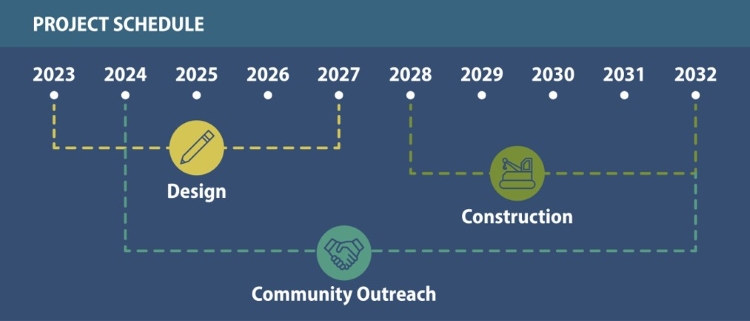
Our team is in the early stages of designing the needed upgrades to EWWTS. Project timelines may change due to a number of factors. We will provide updates as our work progresses and any schedule changes are needed.