
 Translate
Commercial organics diversion
King County businesses can save money and reduce waste by diverting food and yard waste from the landfill! Organic waste collection is less costly than garbage and turns into earth-friendly compost at a local facility.
What are organic materials? What can be composted in my area?
Help create nutrient-rich compost by checking what goes in the organics bin and what stays out. Compost is used on our local landscapes to maintain a healthy environment for plants, animals, and people. See more at Compost Right.
| Materials | Compostable? |
|---|---|
| Food and food scraps, peels, rinds, shells, etc. |
✓ |
| Food-soiled paper and boxes that do not have a waxy/shiny coating |
✓ |
| Plants, flowers, yard waste, and untreated wood |
✓ |
| NO pet waste or diapers |
✕ |
| NO fats, oil, or grease |
✕ |
King County Commercial Organics Resource Program
Businesses can save $7 for every $1 invested in reducing food waste! Launched in 2024, the Commercial Organics Program helps King County businesses save money and reduce waste by providing free technical assistance, waste audits, and start-up materials. The program is part of King County's Re+ initiative to prevent resources from going to landfill [link] and also help businesses comply with the statewide Organics Management Law.
For more information or to request assistance, contact us at organics@kingcounty.gov
Learn how King County's Organics Technical Assistance Program works with local businesses like South Fork Restaurant in North Bend.
WA Organics Management Law: Does my business need to comply?
As of January 1, 2026, businesses in designated areas throughout the state of Washington are required to arrange for organic materials collection. The law is part of a state effort to reduce methane emissions and build more environmentally and economically sustainable food systems. To know if your business needs to comply, follow these two steps:
- Check if your business is in a Business Organics Management Area (BOMA).
Search for your business' address on Ecology's BOMA map. If your address falls within the BOMA, it is likely your business needs to comply. The boundaries of the BOMA are updated each July. As of 2026, the majority of western King County is included.
- Determine what volume of organic waste your business generates in one week.
If your business generates 96 gallons of organic waste per week and is in the BOMA, you are required to comply. 96 gallons is the size of a large curbside waste cart.
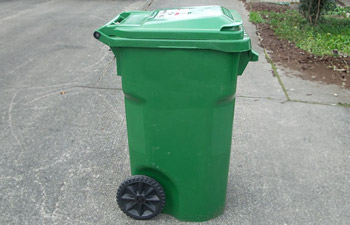
Conducting a "waste audit" is a great way to start. Evaluate how often your outdoor garbage containers fill up and about how much of your container has food/yard waste in it. Estimates are OK! Determine what size your containers are and how often they are serviced by a hauler. If you are at or near the law's threshold, reach out to a waste hauler or explore ways to reduce your organic waste. You can also contact our team at Organics@KingCounty.gov for technical assistance.
Strategies for reducing organic waste at businesses
Donate edible food
By donating edible food to local food banks or meal programs, you can:
- Support those in need in your community
- Prevent food waste in King County
- Lower costs with a reduced garbage bill and/or qualify for a tax deductionInspire employee pride
- Save valuable resources that go into the creation of food
Donors who provide food in good faith are protected by both state and federal Good Samaritan laws. Food rescue organizations have the networks, staff, and infrastructure to distribute food quickly and safely. Donations of almost any type and quantity are needed and welcome!
A list of local hunger relief organizations can be found here
Repurpose and reduce excess food
Find new ways to reduce food waste, such as:
- Explore networks that allow others to purchase unsold food, from single-serve meals to bulk products.
- Offer “day-olds” to customers at a reduced price.
- Evaluate purchasing and back-of-house stocking practices.
- Engage employees and seek their ideas on how to create a more sustainable workplace.
Visit our Food too Good to Waste site for more tips or check out large scale case studies from the Pacific Coast Collaborative.
Establish curbside collection
Some King County cities hold contracts that include organic waste collection for businesses. Check with your city’s recycling coordinator or solid waste lead. For businesses not covered by a city contract, there are a variety of organic waste haulers you may choose to work with, such as:
- Cedar Grove
- Commercial Waste Reduction and Recycling (CWRR)
- Recology
- Republic Services
- Waste Management
For temporary container service, many other providers are available. Visit the What do I do with…? site and search for food or yard waste. King County maintains these lists as a courtesy to the public and does not endorse or guarantee the quality of the service provided. This list should not be considered exhaustive. Don’t see your company? Contact organics@kingcounty.gov.
Manage organic waste on-site
Manage organic waste on-site. Businesses can explore using an onsite "in-vessel" compost system or anaerobic digestor, where organic waste is fully contained and resistant to pests. Learn more about commercial composting and anaerobic digestion. Local companies that offer anaerobic digestion systems include:
- Chomp
- Homebiogas
- Puxin
This list should not be considered exhaustive. Don't see your company? Contact Organics@KingCounty.gov.
Bring yard waste to a King County facility
Businesses can self-haul yard waste to several King County transfer station locations: Bow Lake, Cedar Falls, Enumclaw, Factoria, Shoreline, and Vashon.