
 Translate
Monitoring HIV drug resistance in King County
Background
For people living with HIV, achieving viral suppression through use of antiretroviral (ARV) drugs preserves the health of the person living with HIV and prevents transmission. However, if HIV develops resistance to ARV medications, they may not work as well to prevent severe HIV disease and deaths related to HIV.
Three drug classes are routinely evaluated for resistance: non-nucleoside reverse transcriptase inhibitors (NNRTI), nucleoside reverse transcriptase inhibitors (NRTI), and protease inhibitors (PI). It is recommended that all individuals newly diagnosed with HIV receive NNRTI, NRTI and PI resistance testing. Integrase strand transfer inhibitors (INSTI) are a more recently developed drug class and INSTI resistance testing is currently recommended for people at higher risk of exposure to major INSTI mutations. 1,2 As part of HIV-related public health activities, PHSKC monitors the proportion of newly diagnosed individuals who receive HIV-1 resistance testing following diagnosis and the annual prevalence of ARV resistance.
Proportion of individuals diagnosed with HIV with HIV-1 resistance testing performed within 90 days of diagnosis - King County, WA, 2015-2024
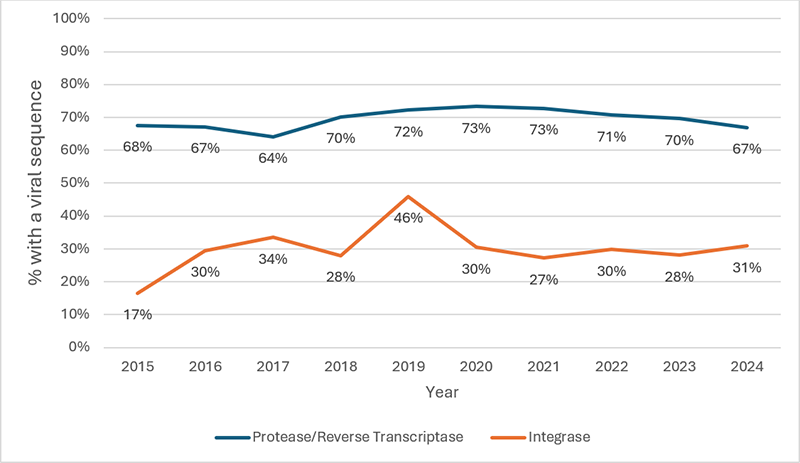
The HIV-1 viral sequences that are reported to PHSKC reflect the protease, reverse transcriptase, and integrase portions of the HIV genome and represent a fraction of the full HIV genome. Resistance testing is not recommended for HIV-2 as testing is not commercially available in the United States and guidance in interpreting HIV-2 mutations is not readily available.3
Transmitted HIV resistance occurs when a person living with HIV who has never been on treatment acquires a strain of HIV that is already resistant to one or more HIV drugs. Among King County residents newly diagnosed with HIV, the proportion with transmitted drug resistance is presented by year and type of resistance.
Prevalence of higher-level transmitted drug resistance among people with newly diagnosed HIV - King County, WA, 2015-2024
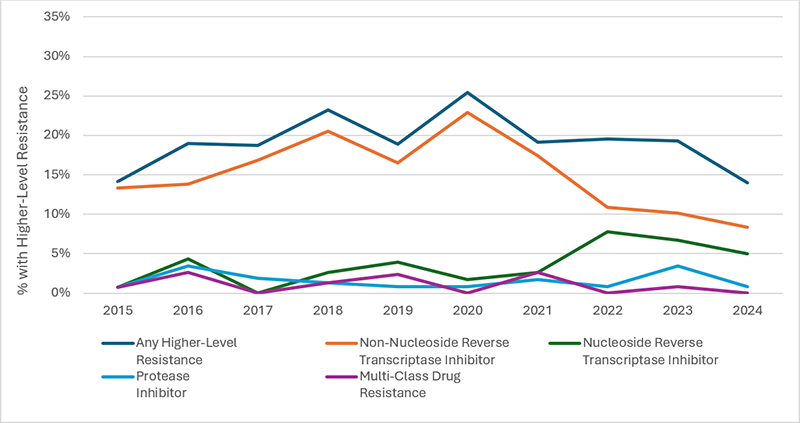
Multi-class drug resistance (MDR) is defined as higher-level drug resistance in more than one antiretroviral drug class (PI, NRTI or NNRTI). The Stanford University drug resistance database website is used for interpretation of the sequences. “Higher-level resistance” refers to the top two resistance scores returned by Stanford’s tool: “intermediate” and “high-level.” INSTI resistance is not included in the figure as transmitted resistance has been rare. Since 2016, only two instances of transmitted INSTI resistance were identified among people living with HIV in King County.
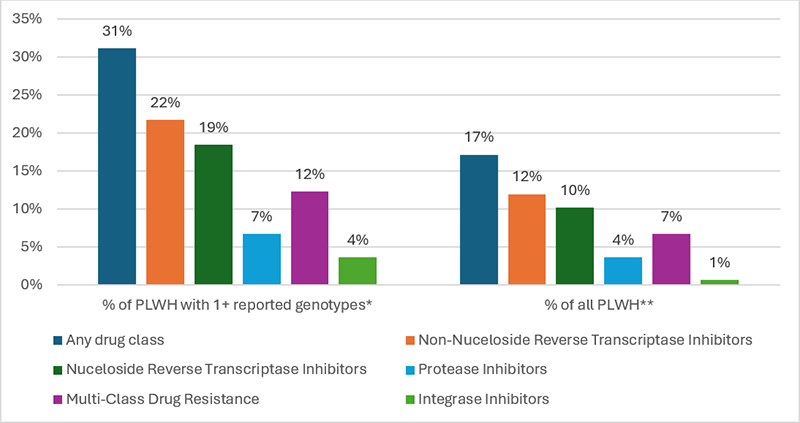
Acquired HIV resistance can occur when a person has HIV that is replicating while also taking ARV medications. This can result in HIV mutations that make the current ARV medication ineffective. The figure below shows the proportion of people living with HIV in King County with either transmitted or acquired resistance.
Prevalence of antiretroviral drug resistance (transmitted or acquired) among people living with HIV - King County, WA 2024
Notes for the figure above:
Summaries utilize all available genotype data. The Stanford University drug resistance database website is used for interpretation of the sequences. “Higher-level resistance” refers to the top two resistance scores returned by Stanford’s tool: “intermediate” and “high-level.”
*Among 4,194 people living with HIV (PLWH) with one or more reported PI/RT genotypes and 1,547 PLWH with one or more reported INSTI genotypes. Proportions were calculated among PLWH with 1+ reported genotypes likely overestimate the true proportion among all PLWH since the most common indication for a subsequent genotype is virologic failure.
**Among 7,611 PLWH in King County in 2024. Proportions were calculated among all PLWH are likely an underestimate of resistance since some subset of people without a reported genotype likely have resistance.
References
1United States Department of Health and Human Services https://clinicalinfo.hiv.gov/en/guidelines/hiv-clinical-guidelines-adult-and-adolescent-arv/whats-new
2International Antiviral Society-USA https://jamanetwork.com/journals/jama/fullarticle/2827545
3 Diagnosis and Management of HIV-2 in Adults. https://www.hivguidelines.org/guideline/hiv-2/