 Translate
Food safety rating system
Learn how we rate food safety in King County and communicate ratings with the public.
Select a topic
Search food safety inspections
Find restaurant inspection histories for food establishments in King County.
Food safety rating categories
Food service establishments receive one of four food safety ratings to provide the public with more information about the level of food safety practices, helping them make informed decisions about eating out. If a food service establishment is permitted and open for business it meets minimum food safety standards to operate.
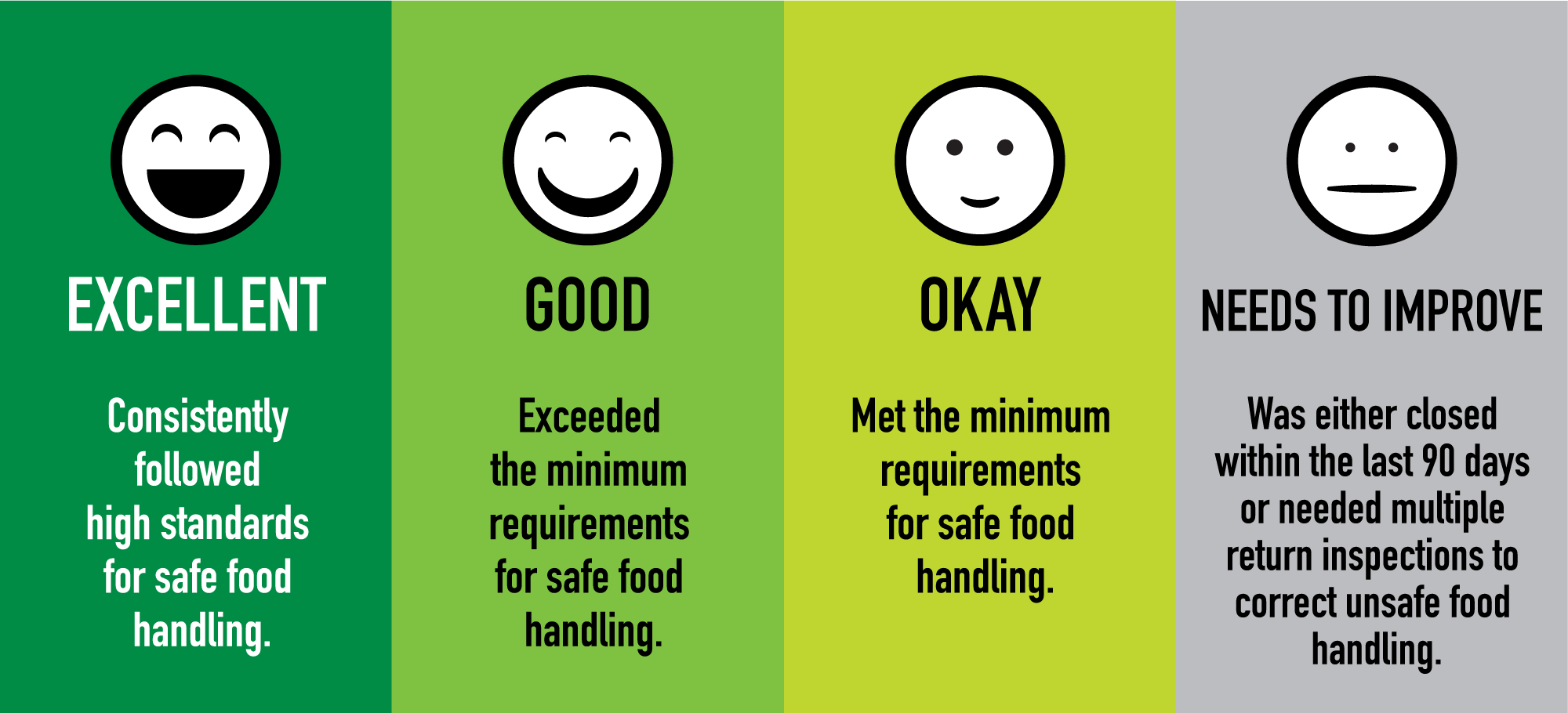
The four food safety ratings are:
- Excellent
Consistently followed high standards for safe food handling. - Good
Exceeded the minimum requirements for safe food handling. - Okay
Met the minimum requirements for safe food handling. - Needs to improve
Was either closed within the last 90 days or needed multiple return inspections to correct unsafe food handling.
The following grade breaks are applied to determine an establishment’s food safety rating, as follows:
| Food Service Establishment Risk Level | Rating | Min | Max | Timeframe |
|---|---|---|---|---|
3 |
Excellent | 0.00 | 3.75 | Average of last four routine inspections |
| Good | 3.76 | 16.25 | ||
| Okay | 16.26 | max | ||
2 |
Excellent | 0.00 | 0.00 | Average of last two routine inspections |
| Good | 0.01 | 5.00 | ||
| Okay | 5.01 | max | ||
1 |
Excellent | 0.00 | 0.00 | |
| Good | 0.01 | 5.00 | ||
| Okay | 5.01 | max |
What is behind a food business's rating?
A food business rating category is determined by two main components:
- Trend of food safety practices over time. Good food safety needs to be practiced every day. The food safety rating signs will reflect how well a business has performed over time, not just on a single inspection. A food safety rating for risk III* food establishments is determined by the average score of unsafe food handling practices of the last four routine inspections. However, for Risk I and II* food establishments, the food safety rating is determined by the average score of up to two routine inspections.
- Scale of performance. King County residents want to know more than if a business passes or fails an inspection. The signs will show how well the business practices food safety beyond meeting the minimum standard.
*See section 4: "Permit types and risk categories" for definitions and examples of risk I, II, and III food establishments.
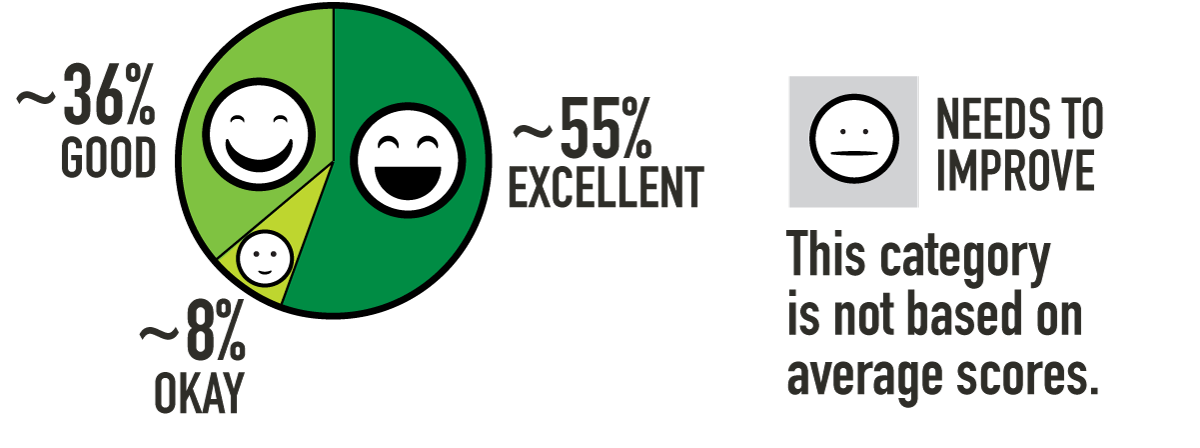
When we implemented this system in 2017, the approximate breakdown of the percentage of businesses that fall into each category was: 55% 'Excellent,' 36% 'Good' and 8% 'Okay.' The 'Needs to improve' category means the business was either closed by Public Health within the last 90 days or needed multiple return inspections to correct unsafe food handling practices. This category is not based on average scores.
Sign posting requirements
In the Food Safety Rating System, businesses are required to post their food safety rating signs. Since every business is different, Food Inspectors will work with business owners to find the best place to post the sign in accordance to the code of the King County Board of Health (218 KB).
According to the code of the King County Board of Health signs must be clearly visible to passersby.
Each sign must be posted:
- Within five feet of the main public entrance so the sign is clearly visible to people passing by or entering the establishment; or
- In a conspicuous location at the establishment as approved by the Food Inspector to ensure the sign is clearly visible to people passing by or entering the establishment.
If signs are not correctly posted according to the rules above, a penalty fee can be charged. Penalty fees are a percentage of a business' annual permit fee. The penalty fee grows incrementally and with each offense.
| Offense (in 2-year period) | Penalty fee |
|---|---|
| 1st offense | 50% of permit fee* |
| 2nd offense | 100% of permit fee |
| 3rd and subsequent offenses | 200% of permit fee |
* Applying a fee that is % of permit cost is more equitable because it is relative scale to the business size.
The above code was passed by the Board of Health on January, 19, 2017. Watch a video of the recorded meeting.
Permit types and risk categories
Who's included in the Food Safety Rating System?
The rating system includes most permitted food businesses in King County: restaurants large and small, coffee shops, bars, delis in grocery stores, catering operations, meat and fish vendors, and mobile food vendors (food trucks and stands). The only permitted food businesses that are not rated are farmers market vendors, food vendors at temporary events, grocery stores, and school food services.
Developing the new food safety rating system
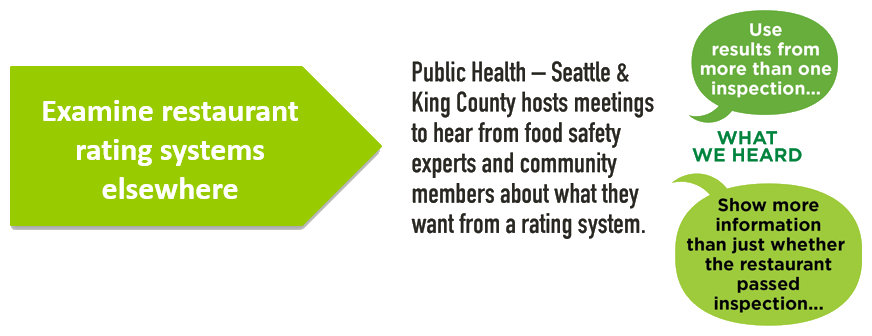
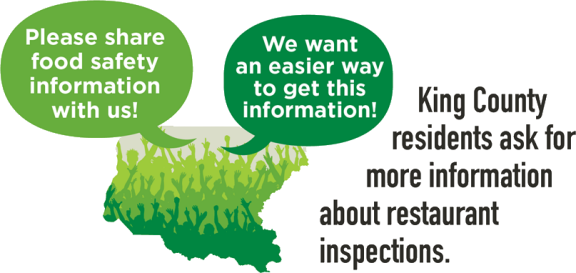
Public Health gathered recommendations, priorities and concerns from restaurant operators, food safety experts, diverse language speaking communities and people affected by foodborne illness. This feedback combined with research, informed the development of the new Food Safety Rating System in 2017.
In 2025, Public Health expanded the food safety rating system to additional permitted vendors, which was widely supported within the food service industry.
Designing the food safety sign
Six sign designs were reviewed by communities across King County to make sure they were easy to understand by people of many different cultures and by people who speak many different languages. We organized community meetings and visited over 100 restaurants to gather feedback on the sign designs and to understand community priorities regarding the new rating system. An online survey, available in English and seven other languages, also gathered feedback on the sign designs. The signs include a number to text to learn more about what a business’s rating means. This information is available in Amharic, Cantonese, English, Korean, Mandarin, Spanish, Somali and Vietnamese.
We've received over 3,500 responses! Thank you for your feedback. We used your feedback to inform the designer of the final sign.
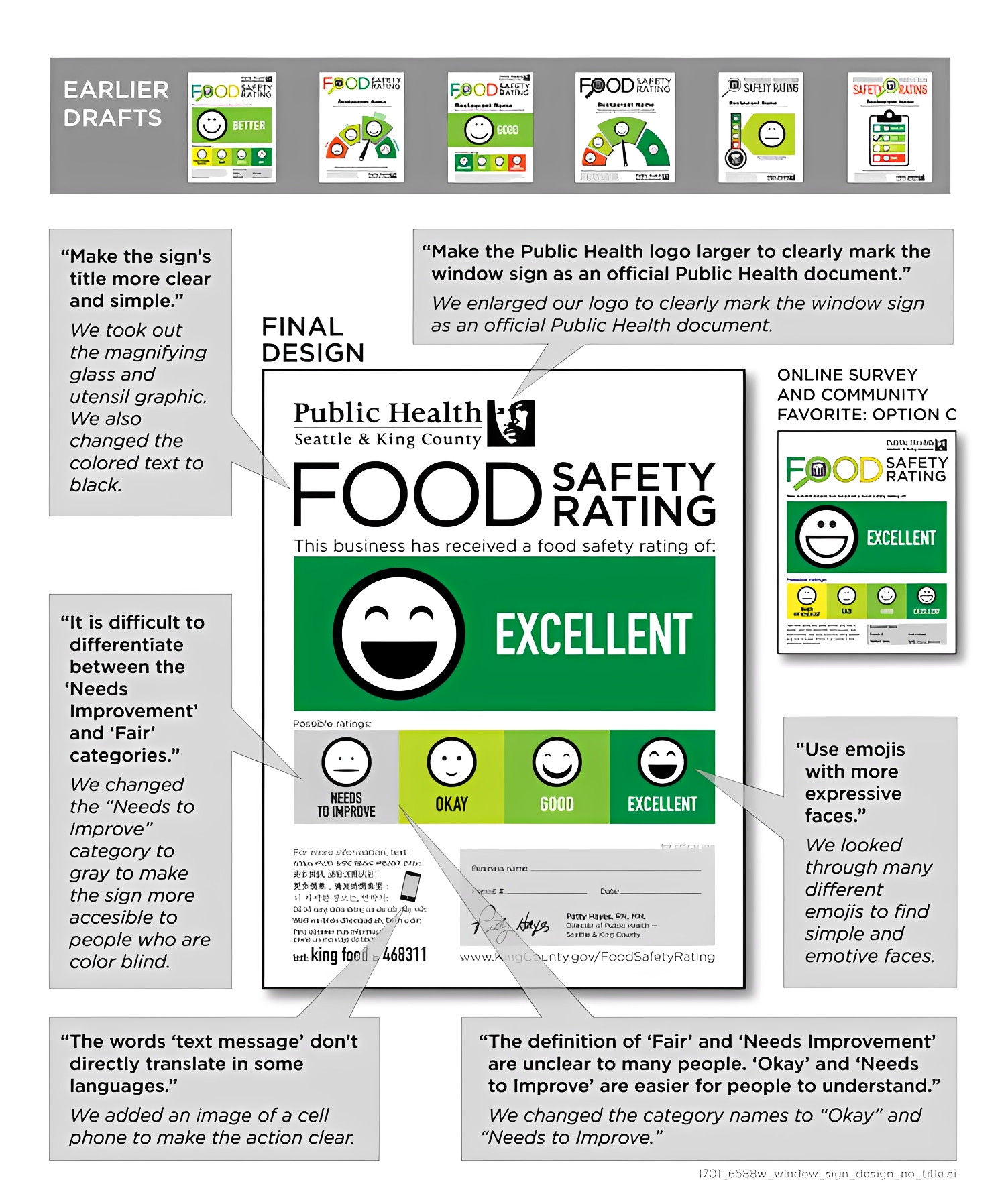
Equity and fairness is important to Public Health — Seattle & King County
The Food Safety Rating System was designed to advance equity and fairness. Here are some ways we incorporated equity and fairness into our system.
- Our rating methods were designed to fairly measure a business's food safety practices by focusing on trend over time, scale of performance, and applying the same standards throughout the county.
- We listened to the concerns of food business operators about food safety inspection consistency. To address this concern we provided extra training and started peer review inspections where staff conduct inspections side by side to learn from each other. This helps make inspectors more consistent with each other.
- The development of the Food Safety Rating System was a collaborative process which included extensive outreach to food businesses, communities, food safety experts and King County residents.
Our food safety rating system will be evaluated in collaboration with community partners. We are committed to making changes based on evaluation results in order to advance equity and fairness.