
 Translate
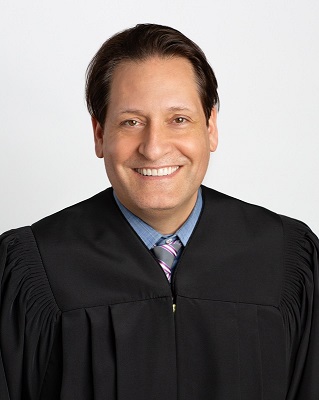
Judge Jason Holloway - Superior Court
- Courtroom Number: E-209
- Bailiff: Renee Janes
- Department: 44
- Assignment: Civil
About Judge Holloway
Judge Holloway was appointed to the King County Superior Court on February 18, 2022, by Governor Jay Inslee. Before his appointment to the bench, Judge Holloway served as a temporary long-term superior court commissioner and was a private practice family law litigator for nearly 20 years.
Judge Holloway is a Fellow of the American Academy of Matrimonial Attorneys, a professional organization family law attorneys which requires state and federal testing and peer review before admission. Judge Holloway is a former president of QLaw, the LGBTQ+ Bar Association of Washington, a former Adjunct Professor in the University of Washington Professional and Continuing Education Paralegal Program and served as a volunteer mediator.
A native of the Pacific Northwest, Judge Holloway moved to Washington after graduating from Willamette University College of Law, where he served as an Associate Editor of the Willamette Law Review. He lives in Seattle with his family.
Email communication with the Court
Before emailing the Court, please review the Superior Court Email Policy.
For all case-related communication with court staff, attorneys and self-represented (“pro se”) litigants must use the courtroom email address: holloway.court@kingcounty.gov. Unless the judge has specifically invited you to do so, do not use Judge Holloway’s individual email address.
Rules to review before contacting the Court
Before contacting the Court about your case, please review the following rules, as they may answer many procedural questions:
- Ex Parte Procedures – King County Local Rule (KCLR) 40.1. “Ex parte” means asking the Court for an order without the other party being present.
- Motions without oral argument – KCLR 7. These are motions decided on written papers only, without a hearing in person or by Zoom.
- Revision and reconsideration – KCLR 7. “Revision” and “reconsideration” are requests asking the Court to review and change a prior ruling.
- Trial continuance – KCLR 40. A “continuance” is a request to move a trial date to a later time.
- Summary judgment – Civil Rule (CR) 56. A “summary judgment” motion asks the Court to decide all or part of a case without a trial based on written evidence.
- Motion to dismiss – CR 12. A “motion to dismiss” asks the Court to end a case or a claim for legal reasons.
- Motion to set aside judgment – CR 60. A “motion to set aside” asks the Court to cancel or change a judgment that has already been entered.
- Motion to compel discovery – KCLR 37. A “motion to compel” asks the Court to order a party to provide information or documents requested in discovery.
- Motion to shorten time – KCLR 7(b)(10). A motion to shorten time asks the Court to change the normal deadlines for hearings or filings.
- Motion to seal – Local General Rule (LGR) 15. A motion to seal asks the Court to restrict public access to certain documents or information in the court file.
CRIMINAL MOTIONS AND SENTENCING HEARINGS
Department 44 is a paperless court and prefers working copies submitted through e-Working Copies. Please clearly label all working copies with Judge Holloway’s name and the case information.
Responses are required on all criminal motions and must be submitted in compliance with KCLR 7(b).
Under Local Criminal Rule (LCrR) 7.1, presentence reports are required in all felony cases and requested in all misdemeanor cases. Please submit your presentence report to the Court and file it with the Clerk.
CIVIL MOTIONS
All of Judge Holloway’s civil motion hearings are held virtually using the Court’s Zoom link: https://kingcounty.zoom.us/j/84323841706. No passcode is required.
Civil Motions - Working Papers and Proposed Orders
Working Copies. “Working copies” are the judge’s copies of the documents you file, used to prepare for your hearing. Department 44 is a paperless court. The Court strongly prefers working copies submitted through e-Working Copies. While not favored, if a party is unable to submit working copies through e-Working Copies, paper working copies may be delivered to the Judge’s Mailroom at the King County Courthouse. All paper working copies must include tabs for each exhibit or attachment.
- The Court does not accept working copies by email unless you have prior authorization from the Court.
- Please clearly label all working copies with Judge Holloway’s name and the case information.
- All motions must be noted according to KCLR 7(b) and filed with the Clerk.
Proposed Orders. A “Proposed Order” is the order you want the Court to sign after considering a motion. For every motion, both sides must submit a proposed order. Each proposed order must be completed as you would like it signed by the judge. Judge Holloway requires a Word version of all proposed orders. You may submit a Word version of your proposed order:
- By email to holloway.court@kingcounty.gov, or
- Through the e-filing portal using the e-Working Copies application.
Dispositive Motions and Requests for Hearing Dates
A “dispositive motion” is a motion that can resolve all or part of a case, such as a summary judgment motion. Dispositive motions are typically heard on Friday mornings. The party requesting a hearing date for a dispositive motion must confer with opposing counsel before contacting the Court; this helps avoid scheduling conflicts.
Parties are encouraged to contact the Court well in advance of trial to schedule a dispositive motion hearing, as available time slots are limited.
Any request for a dispositive motion hearing date and time must be emailed to the Court and must include at least:
- Case number and case name.
- Names, phone numbers, and email addresses of all counsel and self-represented parties; and
- The nature of the hearing (for example, “motion for summary judgment”).
The Court generally allots one hour for dispositive motions. Additional time may be allowed for hearings involving multiple parties or complex issues; please let the bailiff know if you are requesting an extended hearing time.
Most motions do not require oral argument under the Civil and Local Rules. If you wish to request oral argument on a particular motion, note and file the motion according to the applicable court rules and write “Oral Argument Requested” in the upper right-hand corner of the first page of the working papers. After reviewing the written materials, if the Court decides that oral argument would be helpful, the bailiff will contact the parties to schedule a mutually acceptable time. Otherwise, the Court will issue a ruling without oral argument.
Non-Dispositive Civil Motions
“Non-dispositive” civil motions are motions that do not finally resolve all or part of the case, such as discovery or scheduling motions. Parties must comply with all requirements of KCLR 7 and any emergency orders that are in effect when setting motions without oral argument.
All such motions must be submitted as discussed above. Copies of signed orders will be delivered to counsel or the parties electronically if email addresses have been provided to the Court.
Stipulations and agreed orders may be submitted to the Court by emailing them to the bailiff at holloway.court@kingcounty.gov.
Trial procedures
Please review the Department 44 Trial Procedures for Judge Holloway’s court, available here: Department 44 Trial Procedures (PDF).
Jury questionnaire
The standard jury questionnaire for Department 44 is available here: Prospective Jury Questionnaire.[1]
Any proposed additions to the standard questionnaire must be agreed upon by counsel in advance and submitted to the Court in Word format for possible inclusion. The Court will decide whether to add any proposed questions.
Court transcripts and digital recordings
Court proceedings in Department 44 are digitally recorded using FTR Gold equipment. If you know before a hearing or trial that you will want a copy of the recording (often provided on a CD), please let the courtroom clerk know so they may give you the information you need at the end of the hearing.
If you decide after the hearing or trial that you need a copy of the recording, you may obtain it directly from the Clerk’s Office Copy Center. You will need to submit a completed CD Request Form to the Clerk’s Office.
If the parties wish to request a court reporter for a hearing or trial, please notify the bailiff as early as possible.