
 Translate
About the Emergency Medical Services (EMS) system
Any time residents of Seattle and King County call 9-1-1 for a medical emergency, they are using the Medic One/Emergency Medical Services (EMS) system. Serving over 2.3 million people throughout the region, it offers uniform medical care regardless of location, incident circumstances, day of the week, or time of day. The system has garnered an international reputation for innovation and excellence and provides life-saving medical services on average every two minutes.
The system is managed by the Emergency Medical Services (EMS) Division, Public Health — Seattle & King County and relies on collaborative partnerships with dispatch centers, fire departments, paramedic agencies, ambulance companies, and hospitals to make the program seamless and successful. These deep-rooted partnerships provide a continuum of consistent, standardized medical care that allows the system to excel and achieve the best possible patient outcomes.
The Medic One/EMS system in Seattle and King County uses a layered response (referred to as a tiered system) so that 9-1-1 callers receive medical care by the most appropriate care provider. Calls to 9-1-1 are received by dispatchers who use specific dispatch triage guidelines to determine the level of care required. Emergency Medical Technicians providing Basic Life Support (BLS) services are the "first responders" to an incident and provide immediate medical care. In more critical or life-threatening situations, such as cardiac arrest, paramedics providing Advanced Life Support (ALS) services respond to the scene. Once a patient is stabilized, it is determined whether they need further medical attention and transport is provided either by an ALS agency, BLS agency, or private ambulance.
EMS Tiered Response System
-

Access to the EMS system
Bystander calls 9-1-1
-
Triage by dispatcher
Use of Emergency Medical Response Assessment Criteria

-
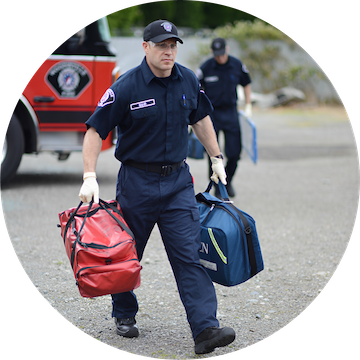
First tier of response
Basic Life Support (BLS) by firefighter/ EMTs
-
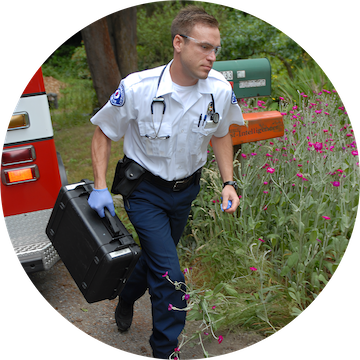
Second tier of response
Advanced Life Support (ALS) by paramedics
-
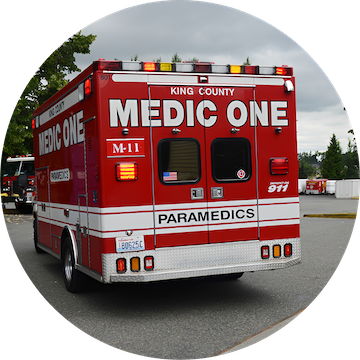
Additional medical care
Transport to hospital
About the Tiered System
A patient or bystander accesses the Medic One/EMS system by calling 9-1-1 for medical assistance. Bystanders' reactions and rapid responses to the scene can greatly impact the chances of patient survival – studies have shown that survival rate increases from 10 percent to 43 percent if cardiopulmonary resuscitation (CPR) is given within four minutes, and defibrillation in less than eight minutes. The EMS Division offers programs to King County residents so that they can administer life-saving treatments on the patient until providers arrive at the scene.
9-1-1 calls are received and triaged by telecommunicators at one of four dispatch centers. Dispatchers are the first point of contact with the public, asking medically based questions to determine the appropriate level of care to be sent (BLS, ALS or referral to the Nurseline). Amid a wide range of needs, they provide pre-hospital instructions and even guide callers through providing life-saving steps such as CPR and using a defibrillator until the Medic One/EMS providers arrive.
BLS personnel respond to 100% of emergency medical calls and are usually the first responders to an incident, providing immediate basic life support medical care (e.g. airway management, rescue breathing, bleeding control, CPR, defibrillation) and stabilizing the patient. Staffed by firefighters trained as emergency medical technicians (EMTs) aboard fire trucks and aid cars, BLS arrives at the scene in less than five minutes (on average). Some non-emergent calls qualify to be referred to a nurse line for medical advice and care instructions in lieu of dispatching EMS resources. The 4,300 EMTs in Seattle and King County are required to complete quality BLS initial and ongoing continuing education and training to maintain certification. More information about BLS education.
Paramedics provide out-of-hospital emergency medical care for critical or life-threatening injuries and illnesses. As the second on scene, they provide airway control, heart pacing, the dispensing of medicine, and other life-saving procedures. ALS is provided by highly trained paramedics who have completed an extensive program at Harborview Medical Center in conjunction with the University of Washington School of Medicine and are certified by the state. These paramedics remain well practiced and use their skills routinely to provide effective care when it is needed most.
Regional seamless paramedic services are provided by five agencies operating 27 ALS units strategically placed across King County, including fire departments in Bellevue (4), Redmond (3), Shoreline (3), Seattle (7), and King County Medic One (9). Although administered through different agencies, all are part of the Medic One system, and will respond county-wide as the need arises. A contract with Snohomish County Fire District 26 provides EMS services to the Skykomish and King County Fire District 50 area, from Baring to Stevens Pass. The 270 paramedics in our system have received over 2,500 hours of intensive training through the University of Washington/Harborview Medical Center Paramedic Training program.
Once a patient is stabilized, EMS personnel determine whether transport to a hospital or clinic for further medical attention is needed. Transport is provided by an ALS or BLS agency, private ambulance, or taxi/ride-share options for lower-acuity situations.
About the EMS Division
The EMS Division manages the core Regional Services and Strategic Initiatives that support the key elements of the system. These services are essential to providing the highest quality out-of-hospital emergency care available.** They ensure that hospital patient care is delivered at the same standards across the region, regional policies and practices that reflect the diversity of needs are maintained, and local area service delivery is balanced with centralized interests.
The EMS Division consists of five coordinated sections (see below) that work together to provide integrated regional leadership. Collaborating with county partners, these teams manage and deliver data collection, analysis, and systemwide planning; medical oversight; training and education for EMTs, dispatch centers, and the public; community outreach to expand access to care; and research that advances best practices. Thanks to the work of these professionals, King County is able to deliver high-quality, emergency medical services that are recognized nationwide for their excellence.
Also embedded within the EMS Division is King County Medic One, which provides paramedic services to south King County. King County Medic One is one of five paramedic providers in the regional EMS system. Its 78 paramedics work side-by-side with local fire department personnel to provide the highest-quality, cost-effective emergency medical care to those in need, 24 hours a day, every day of the year. Visit King County Medic One for more information.
** The EMS Division provides these services to all of King County outside the City of Seattle - all EMS services within the City of Seattle are coordinated through the Seattle Fire Department.
Five coordinated sections
-
Administration
The Administration section of the EMS Division provides leadership and essential support that ensure day-to-day operational activities within the EMS system. It actively engages with regional partners to implement the EMS Strategic Plan and undertakes long-term programmatic and financial planning, such as the management of levy funds, and preparation of the annual budget and monthly monitoring and projections. Its responsibilities include contract management with ALS and BLS agencies, personnel-related activities, and managing the continuity of business in collaboration with EMS partners.
-
Community Programs
The Community Programs section of the EMS Division makes countless connections throughout the EMS system and broader King County area. It offers a wide variety of public awareness and education programs to an equally wide variety of communities, such as school aged children, adults, and EMS partners. This includes programs on Injury Prevention; Cardiopulmonary Resuscitation (CPR) and Automatic External Defibrillators (AEDs) use; recognizing medical emergencies and appropriately calling 9-1-1 for medical assistance; emergency medical dispatch training and quality improvement; and BLS response tier efficiencies that support referring patients to health and social services, transportation options for certain incidents, and other efforts to efficiently handle low-acuity calls.
-
Equity Pod
The Equity Pod strengthens how the EMS Division works together to advance equity, racial justice, and social justice across the entire EMS system. This structure combines several important programs under one coordinated umbrella, helping the Division better serve the people of King County with fairness, respect, and cultural understanding. This includes strengthening and expanding the EMS Community Health Outreach (ECHO) program; embedding equity and racial justice into EMS policies, training, and daily operations; and supporting DEI and mental wellness efforts across our fire and EMS partners. The Equity Pod demonstrates the EMS Division’s commitment to building an EMS system where everyone—no matter their language, background, or neighborhood—has access to compassionate, culturally responsive emergency care.
-
Regional Quality Improvement (QI)
The Regional Quality Improvement (QI) section of the EMS Division conducts programmatic, scientific, and case based evaluations of the EMS system to improve the quality of EMS patient care in King County. It is divided into three distinct units: the DREAM Team which manages our Cardiac Arrest system and provides continuous QI feedback on resuscitation attempts; the DAT team which provides quality data to help the region with long-term planning, EMS system monitoring, and program evaluation; and CEEMS which supports research in the field of pre-hospital emergency care for cardiac events. The results of these medical quality improvement efforts improve care, patient outcomes, and subsequently, the health of King County residents. The Regional QI section’s ongoing surveillance helps identify impacts on specific county populations that can then drive future strategies, allowing the EMS Division to be an active partner in King County’s community-based policies and response efforts.
-
Training & Education
The Training & Education section of the EMS Division is responsible for the initial training, continuing education, instructor training, and recertification oversight for approximately 4,900 Emergency Medical Technicians (EMTs) practicing throughout King County. It works collaboratively with its regional EMS partners and the King County Medical Program Director (MPD) to develop and support the curricula to meet state, national and agency requirements. In addition, the Training & Education Section serves as the liaison between King County’s 23 fire agencies that provide basic life support services and the Washington Department of Health (WA DOH) for initial certification, training authorizations, certification renewals, and regulatory or policy updates affecting the delivery of EMS.
Articles from the Public Health Insider blog
- Why King County's EMS is the best in the world: Q&A with Mickey Eisenberg
- Many partners, one leading EMS/Medic One system
- EMS teamwork saves teen
- Caring for the mental wellness needs of EMS providers
- CPR in a Box is a lifesaver
- Four numbers that count for Medic One/Emergency Medical Services
- EMS/Medic One doctor talks reasons for survival success
- Restarting hearts: CPR/AED trainer fosters a community of lifesavers
- Saving lives on the paramedic beat
- First and fast care: Emergency Medical Technician on the scene
- Life on the line: Meet a voice of 911
- Feel the pulse of a King County paramedic