
 Translate
Installing gas piping
How to properly size your gas piping system. Use this information to determine if an existing gas pipe has the capacity to add an exterior barbecue or fire pit.
Find the right size of gas piping for your project
The sizing chart provided below is only applicable when:
- Gas type is natural gas.
- The inlet pressure is 0.5 psi or less.
- The allowable pressure drop is 0.5 inches water column.
- The specific gravity of the gas being supplied is 0.60.
For other design conditions, reference appropriate sizing chart provided in chapter 4 of the Fuel-Gas Code.
Pipe sizing chart
| Pipe size (inches) | Length (feet) | ||||||||||
|---|---|---|---|---|---|---|---|---|---|---|---|
| 10 | 20 | 30 | 40 | 50 | 60 | 70 | 80 | 90 | 100 | 125 | |
| 1/2 in. | 172 | 118 | 95 | 81 | 72 | 65 | 60 | 56 | 52 | 50 | 44 |
| 3/4 in. | 360 | 247 | 199 | 170 | 151 | 137 | 126 | 117 | 110 | 104 | 92 |
| 1 in. | 678 | 466 | 374 | 320 | 284 | 257 | 237 | 220 | 207 | 195 | 173 |
| 1-1/4 in. | 1,390 | 957 | 768 | 657 | 583 | 528 | 486 | 452 | 424 | 400 | 355 |
| 1-1/2 in. | 2,090 | 1,430 | 1,150 | 985 | 873 | 791 | 728 | 677 | 635 | 600 | 532 |
Determine proper size of piping
Proper sizing of the pipe is important so that each gas appliance receives enough gas to perform properly. Each appliance has a minimum input demand in BTUs per hour.
The chart immediately below gives some examples of typical BTU demands. Use the pipe sizing chart provided above to assist you in determining the proper pipe size for your job. To convert from BTUs to cubic feet per hour, divide BTU by 1100 (example: 50,000 BTU by 1100 = 45.45 cubic feet of gas per hour). To get BTU from cubic feet, multiply cubic feet x 1100 (45.45 cubic feet x 1100 = 50,000 BTU.) See the example problem following the BTU table to show you how you use the sizing chart.
Minimum demand of typical gas appliances in BTUs per hour
| Appliance | Demand in BTU/hour |
|---|---|
| Barbecue (residential) | 40,000 |
| Domestic clothes dryer | 35,000 |
| Domestic gas range | 65,000 |
| Domestic recessed oven section | 25,000 |
| Fireplace gas log | 80,000 |
| Gas refrigerator | 3,000 |
| Storage water heater, 30 to 40 gallon tank | 35,000 |
| Storage water heater, 50 gallon tank | 50,000 |
Example problem: How to properly size a gas piping system
Use this example to make sure you understand the sizing process correctly before installing a new system or adding on to an existing system.
Using the sizing chart provided below, determine the required pipe size of each section and outlet of the piping system shown.
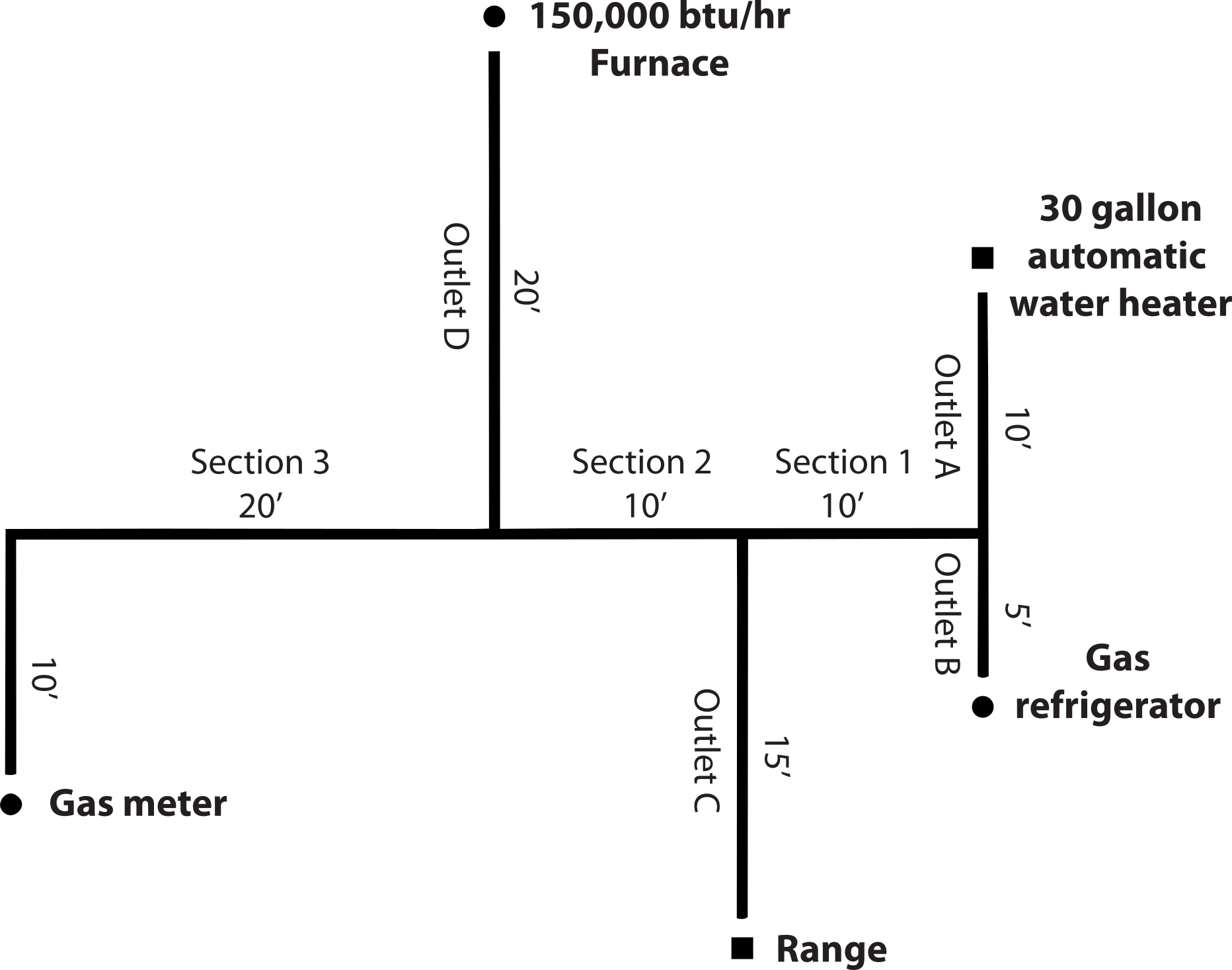
Solution:
1. Maximum gas demand of outlet A - 35,000 BTU per hour/1100 BTU per cubic foot = 31.82 cubic feet per hour.
Maximum gas demand of outlet B-3,000 BTU per hour/1100 BTU per cubic foot = 2.73 cubic feet per hour.
Maximum gas demand of outlet C-65,000 BTU per hour/1100 BTU per cubic foot = 59.09 cubic feet per hour.
Maximum gas demand of outlet D-150,000 BTU per hour/1100 BTU per cubic foot = 136.36 cubic feet per hour.
2. The length of pipe from the gas meter to the most remote outlet (outlet A) is 60 feet.
3. Using the column marked 60 feet on the size of gas pipe chart:
Outlet A, supplying 31.82 cubic feet per hour, requires 1/2-inch pipe.
- Section 1, supplying outlets A and B, or 34.55 cubic feet per hour requires 1/2-inch pipe.
- Section 2, supplying outlet A, B and C, or 93.64 cubic feet per hour requires 3/4-inch pipe.
- Section 3, supplying outlets A, B, C, and D, or 230 cubic feet per hour, requires 1-inch pipe.
4. Using the column marked 60 feet: Outlet B supplying 2.73 cubic feet per hour requires 1/2-inch pipe. Outlet C, supplying 59.09 cubic feet per hour, requires 1/2-inch pipe.
5. Using the column marked 50 feet: Outlet D, supplying 136.36 cubic feet per hour, requires 3/4-inch pipe.
Approved gas piping fitting materials
Black iron and corrugated stainless steel (CSST) are commonly used approved materials. CSST requires certification from the manufacturer for anyone who is going to purchase and install the material.
Cutting pipe
If you are cutting iron pipe, you must ream the cut of your pipe, so you maintain the full inside diameter of the pipe.
Special instructions
Do not use ground joint unions except directly at the meter or after the shutoff valve at the appliance. Each place where you will have a gas appliance must have a gas shutoff valve. Within the City of Seattle only, a Seattle Gas Piping Mechanic License is required by anyone who installs gas piping on property they do not own. All gas piping installations require a permit and inspection.
Testing
Testing the system is your responsibility. The inspector does not perform the test or provide any of the equipment necessary for the test, including test gauges.
An air pressure test is required. The test pressure shall be at least 1 ½ times the working pressure, but no less than 3 pounds per square inch (psi). The test duration must not be less than 10 minutes. The piping system must withstand the test pressure specified without showing any evidence of leakage or other defects.
Mechanical gauges used to measure test pressures shall have a range such that the highest end of the scale is not greater than 5 times the test pressure. For instance, a 3 psi test will require a maximum 15 pound gauge. A 10 psi test could be performed using a 50 pound gauge, but not a 100 pound gauge. The piping system must be under test (pressurized) and the test gauge visible at the time of inspection. Where the gauge does not indicate the minimum pressure required for the test, or any reduction of test pressures as indicated by pressure gauges during inspection shall be deemed to indicate the presence of a leak.
If there is a drop in pressure, check for leaks. Check for leaks by filling a spray bottle with soapy water and spraying the solution on the pipe, where it meets the fittings. Bubbles show a leak, and you should repair it appropriately. Continue this process until you have no leaks. Do not use an open flame to test for leaks.
Inspection
At the time of inspection, be sure to leave all of the gas piping exposed so the inspector can look at the whole system.